Inspired by glazed panels
in the historic..
1904 Astor Place Subway Station
New York City

~ I present ~
Beaver panel Nr S1-R
Modelled by Randall


NOTE:  This clay model is finished and cast available.


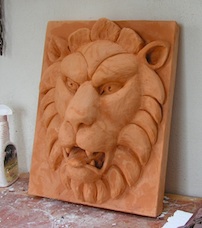
Below are some studio photos of my orginal clay model during it's various creation and finishing  stages. These clay models are NOT molded copies taken off antiques, but were hand sculpted by Randall in the same style and configurations as 19th century and Art Deco architectural sculptures.

Molds made of my clay models enable clients to purchase cast-stone or concrete  casts of my models for wall decoration, garden or incorporating into a brick wall in new construction in a variety of finishes.


Please read the entire auction page, it contains details on finishes, shipping and many answers to the more common questions people have

Hand cast replicas of my sculpture  will be available in interior cast-stone in your choice of several finishes.

HISTORY

The beaver is a nominal 22" x 14",  bas relief and after a design by Grueby Faience Co 1904. Grueby custom made tiles and ornaments for the NYC subway stations, and at the Astor Place station these beaver plaques were installed in tribute to John Jacob Astor who made his fortune with beaver pelts in the 19th century, and for whom Astor Place was named.

The Interborough Rapid Transit Subway, or IRT, was the first subway company in New York City, and opened on October 27th, 1904
Astor Place station was built in large part under what had been private property along the west side of Astor Place. Several buildings were demolished to make way for the station accounting for today's odd shape of Astor Place.
The heavy brick-faced square columns on the downtown platforms support the old John Wanamaker (now K-Mart) store above them. The octagon windows on the brick wall of the platform were the store's showcases. K-Mart has reopened a direct entrance to their store from the southbound platform, which had been sealed for many years after the demise of the Wanamaker's store at that location.

Station Decoration.

  • Plaques: Beavers. Grueby Faience Co. 1904.
  • Name tablets: Grueby Faience Co. 1904.
From forgotten NY;

The beavers whose pelts made Astor rich are depicted in the station by Grueby. This is the first station on the line in which a graphic element of this type was executed: there would be many more in the IRT and continuing on new BMT construction on into the 1920s. While later stations would use mosaics, though, here faience was used, and you can see what we meant by rich color. The beaver, resting on a tree stump and gnawing on a trunk, is surrounded by the bellflower motif and also by the precise geometric shapes, squares and diamonds, that are also a hallmark of original subway stations: the diamond surrounded by four squares is repeated at other stations further up the line. At 22.5x14 inches these plaques are the largest in the system (excluding station name plaques), and the ten-inch borders give them added size.

Extant tiles in the subway station


Architectural Designs For New York's First Subway

David J. Framberger
Survey Number HAER NY-122, pp. 365-412

Historic American Engineering Record
National Park Service
Department of the Interior
Washington, DC. 20240


There were 49 stations on the Contract One subway, thirty-seven underground and twelve above. The underground stations, except for City Hall. No two station plans were exactly alike, but the standard local station was a "T" shape, with "arms elongated parallel to the track," and "stem under the street transverse to the main route.
The raw brick walls and concrete ceilings were then turned over to Heins and LaFarge to be "beautified." The decorative scheme that they devised was certainly influenced by Parsons, for it is again similar to the Paris Chemin De Per De Sceaux in its system of wall division and ornamentation. Heins and LaFarge's plans were subject to the final approval of Parsons, who delegated authority to D. L. Turner, assistant engineer in charge of stations for the Rapid Transit Subway Construction Company. August Belmont also oversaw station decoration; he approved of the first completed station at Columbus Circle, but complained of the use of too much brick at Astor Place, 50th Street, and 66th Street.

In general, the station finish consisted of a sanitary cove base that made the transition from floor to wall, upon which rested a brick or marble wainscot for the first two and one-half feet or so of wall area. This wainscot was applied to withstand the hard usage that the lower wall would be subjected to. The wainscot was completed by either a brick or marble cap, and the remainder of the wall area was covered with three by six-inch white glass tiles, completed near the ceiling by a cornice or frieze. The wall area was divided into fifteen foot panels, the same spacing as the platform columns, by the use of colored tiles or mosaic "in order to relieve the monotony that a plain-tiled surface would present." The full station name appeared on large tablets of either mosaic tile, faience, or terra-cotta at frequent intervals, while smaller name plaques were incorporated into the cornice every fifteen feet.
A conscious effort was made by the architects to create a distinct wall treatment for each station, both to relieve monotony and assist in the identification of different locations, and the "extent of the decoration varies with the relative importance of the stations." Wherever possible, a local association was worked into the decorative scheme, such as the seal of Columbia University at 116th and Broadway. Heins and LaFarge used a number of different details to add interest to the stations. All of them were classically derived but designed with considerable artistic license. Examples of these details include the cornices at all stations, garlands such as at 116th and Broadway, cartouches such as at Spring Street and along the Lenox Avenue line, and flat pilasters and Greek Frets such as at 79th and 86th Streets.

The quality of materials specified by Heins and LaFarge for use in the stations was extremely high. The wainscot was constructed of either buff-colored Roman brick or marble. The vent grills and light fixtures were of bronze, and the ticket booths of oak. Encaustic mosaic tile was used for the color bands and name tablets. Architectural details were executed in either glazed terra-cotta or in faience for the more important stations. Faience is terra-cotta with a more refined glaze requiring two firings which produce an opaque mat glaze. The materials were of such high quality, in fact, that their use had to be curtailed because of expense. Parsons noted in his construction diary, February 27, 1902, that he discussed reducing the expense of stations with LaFarge. By January, 1903 Parsons advised a simpler treatment for stations, and by the next month he ordered that the use of marble should be discontinued except for those stations already contracted for.

  • Material Subcontractors:
    Grueby Faience Company, Faience
  • Color Scheme:
    Blue faience tablets
    Light blue tile bands
    Blue faience cornice
    Blue faience plaques
    Marble wainscot cap

    Astor Place

  • Material Subcontractors:
    Manhattan Glass Tile Company, Tiles
    Grueby Faience Company, Faience
  • Color Scheme:
    Blue faience tablets
    Blue tile bands
    Green faieence cornice
    Blue faience plaques
Harper's Weekly · January 31, 1903 · p. 176.

The decorations will be of tiles, faience, and glazed terra-cotta, with the name of the station plainly marked in panels. All the ornamentation has been designed to help the passenger recognize his station without the necessity of listening for the announcement of the of the guard or reading the signs.


General information etc applicable to all of my sculptures

NOTE: My standard cast-stone is for INTERIOR OR UNDER A COVERED PORCH/SUN ROOM ONLY! Out in the garden they might last 4 or 5 years, maybe longer before showing weathering damage.

  1. If you are looking for something to place in the garden or build into a wall, I offer concrete as a special order item which takes approx 3 weeks. Not all pieces are available in concrete, inquire before ordering.
  2. All of these sculptures have a heavy wire embedded on the back to hang them on the wall.
  3. I own the originals, copyrights in most cases, and the molds, I can produce any quantity and custom configurations as well.
  4. All of my sculptures are personally hand-cast in my home studio, they are signed, numbered and dated. These are finished to order at the time of purchase.

Randall featured in the New York Times Sunday May 20th, 2007 City section Pg CY9


FINISHES AVAILABLE

I offer at least 5 different finishes, on certain pieces- 2 metallics are standard.
Finishes are YOUR CHOICE which you want on your sculpture.
 They vary from piece to piece, and actual colors displayed on your monitor will vary as well.

From left to right in the  photo below, they are;

  1. Old Dirty Bronze (metallic)
  2. Old Dirty Nickel (metallic)
  3. Dirty limestone grey- varies from near black to very light grey.
  4. Buff yellow.
  5. Red terra cotta.

SHIPPING

I use DHL ground service for all shipments in the lower 48 states. I no longer ship outside the US.

Shipping charges if displayed here, are for my standard INTERIOR cast-stone versions only!


NOTICE:

Designs in the Lost New York City Collection are  copyrighted with all rights reserved, this includes reproductions of antique pieces upon which I made certain modifications, alterations or changes- the changes are copyright and reproduction of same would constitute copyright infringement. I do not sell molds, nor casts for others to replicate and will enforce my proprietary rights. I reserve the right to decline sales to anyone.

Original clay models by Randall all carry my impressed model numbers and dog paw-print logo, date of creation and signature on one of the sides, the casting number and casting date are inscribed by hand on the back of every cast.


28" COMPLETED CLAY MODEL

~Coming this winter~

Griffin Nr. 90-R
Inspired by a series of sculptures on 90 West Street NYC, a 1906 Cass Gilbert gothic styled  landmark office building damaged on 9/11


28" long CLAY MODEL
WORK IN PROGRESS

~Coming this winter~

Full bodied Griffin-Gargoyle on base Nr. 168-R
Inspired by a series of dormer sculptures on the former Public School 168 105th st 1st Ave NYC.  WM H. Gompert, Architect- circa 1906.


Randall, Owner and webmaster of
Randall's Urban Sculptures web gallery, and sculpture studio.
A historical photo essay of lost buildings from NYC's architectural history.

All photos and accompanying text are (C) Randall's Urban Sculptures Collection, all rights reserved.