Archive for May, 2008

Angel model Nr 713-R

Now I have the design started, I started impressing a ball peened effect for the background which was effective on other pieces, and I just didn’t like how it looked on this- too distracting, maybe because the proportion of background to the design is greater. So I smoothed it back and went with a raked texture. I think the head is coming along though she looks like an older female than I had intended, not sure what I need to do yet to take some years off, or if I might WANT to stay with the older look.

Comments Off

Randall on May 31st 2008 in Architectural models

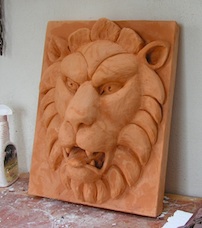
Plaster lion artifact

I purchased this plaster lion recently, arrived today in fact, and I am pretty certain his origins was a demolished theater, probably in Indiana wheret he seller is.
He was once painted silver and then a couple of times with gold paint, the last coat of paint which due to the patina and grime must have been many years ago- was gold.

About the only place they would paint such plaster ornaments either bright silver OR gold would be a theater. Some hotels from the era might also have this type of decoration but hotels having this type of ornament would usually be kept very clean and painted frequently- two strikes against this having come from a hotel.
As there appears to be only about 4 coats of paint at best on the lion, this further fits the theory of a theater- they rarely paint the interiors because for the most part it’s usually dark, not well lit when the house lights are on, and the size of the room means these ornaments and the ceiling are far enough away from patron’s eyes they couldn’t tell if it was dirt or paint.

I will date this to crca 1920 or to the teens, he has some similarities to my Chicago Corn Exchange Bank cornice lion from 1906- post Victorian era with more streamlined and suggested details, especially in the top knot.

“Dissecting” his construction, it’s clear that the lion mask was cast shallow in a mold, and the backing moldings which consist of two running lineal sections- upper was egg & dart, lower was bead and reel- were made in a curious way- the actual egg and darts and the bead an real designs were cast separately in long strips and then inserted into premade backers that had to have been made by running a shaped template along a “track” in situ, the separately cast details were then applied onto those shaped-in-place backers.

Comments Off

Randall on May 27th 2008 in Architectural models

Next model

Working on a small horizontal panel with an angel after those that were once on 713,715,717,719 and 721 East 5th Street.

Should wind up around 19″ wide

Comments Off

Randall on May 27th 2008 in Architectural models

Bank ad

I bought an 1895 book by Moses King which has about 450 photos of New York in it, a lower quality scan of the entire book is in the Google archives.
Seems to be a hot item as the copies I see on Ebay and elsewhere usualy have pricetags around $300-$450, but I found an ex library copy for $100 in reasonable condition.
According to King’s book he printed 30,000 copies of it at least to that point- the first edition.
Interestingly enough, that while it’s touted as a photographic book of New York City with 450 illustrations $1.00, as you browse the pages you notice a curious thing- the text pages all seem to be ADS, and the following page for each is a photo of the building the company detailed in the text owns.

So, it looks like King solicited ads from these companies and cleverly worked them into the “photos of NYC” book, so it starts out with the big Wall street area insurance companies, banks, investment agents, real estate agents, brokers and goes up North a bit to the dry goods, milinary, notions, clothing and merchandise companies, hotels and more.
Many if not most of the buildings are long gone.

Here’s a typical text page opposite the photo that accompanies them, what is funny to consider when reading this boast ad for the bank, is that it says they had $200,000 in Capital and a whopping $2,000,000 in deposits LOL! In today’s money that amount would be chump change by comparison to the billion dollar companies now. However, with inflation, $200,000 in 1895 is worth $4,735,670 and $2,000,000 in deposits is worth about $47,735,670 in 2007 money.

Comments Off

Randall on May 18th 2008 in Architectural models

Iron corbel

More pieces acquired from Nashville, Tn, this is not from the 1856 Morgan-Reeves building discussed further back, but it’s clear this casting was made in the same foundry- ir’s almost identical to one of the corbels in the Morgan’s parapet cornice except it is smaller and has a molding on top.
This came from another building demolition near there, in the 1970′s and was cast in the same decade for sure.

Comments Off

Randall on May 16th 2008 in Architectural models

Postcard

A studio portrait circa 1900 by G. P. Heusted, an Adams NY photographer, purchased on Ebay;

The Dwight Block was built in 1885 on the corner of Main Street and Railroad Street (now W. Church St.)
The Dwight Block was a three stroy brick building, measuring 53′x64′ and was completed in October 1885. The first floor has three stores with full plate glass windows and a stairway to the upper floors.

Huested Photo Studio (c.1890-1923) occupied space in the block.

ADVERTISER IN THE 1923 ADAMS NY ANNUAL: Huested’s Studio, Adams, NY

Ad in the March 5th, 1889 Jefferson county journal;

—G. P. Huested’e Adams gallery will be
open every Tuesday, Thursday and Saturday
in March, from 9 A.M. to 8 P.M

Comments Off

Randall on May 13th 2008 in Architectural models

First cast

Of the subway beaver model Nr S1-R

Comments Off

Randall on May 5th 2008 in Architectural models

Carved wood consoles

From Belgium or France, very nice work, purchased for $400

These were probably installed in a cornice upside down, in which case they would be called Modillions.

Modillion: An ornamental bracket or console, usually in the form of a scroll with acanthus, supporting a cornice.

In architecture, a type of bracket, or corbel, particularly one with a scroll-shaped profile: usually an S or inverted S curve, terminating in volutes (spirals) above and below. A console projects about 1/2 its height or less to support a windowhead, cornice, shelf, etc. The difference between a console, modillion and other varieties of cobel type brackets has more to do with it’s placement, arrangement and purpose than it’s specific shape, style or form.

Example of two modillions in a cornice;

Comments Off

Randall on May 5th 2008 in Architectural models