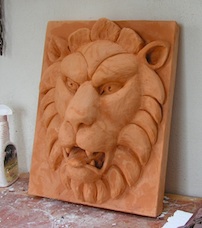
Interestingly enough I found another round medallion, this one is 21″ across and glazed terra cotta.
The seller has story about it but it seems somewhat dubious.
He claimed it came from a ww2 bombed building in Europe and the guy he got it from brought it back with him as a memento and had it in his garden all this time.
He was going to use it in his rec room but it unnerves his wife and she wants it gone lol.
He said he thought it was lucifer from a St Michael slays the devil theme, but I don’t know, every such depiction Ive seen there is always the 2 figures, St Michael with the sword standing on the devil laying prone.

This figure seems far too “tame”, too “dressed” in clothing to be a depiction of lucifer, and being a sole portrait makes it more doubtful it’s a St Michael related theme.

It does seem to have 2 horns, but it looks a lot like he is wearing a helmet of some kind, so its possible the “horns” are part of that, or maybe its a depiction of Pan, who had horns and was a common motiff, anyway, I got it for only $400 so that’s not bad at all, but the crate and shipping on top was $278.08, it’s 104# and in the crate it was 130#

Raised numbers on the top edge say 25196DP2 which is the same system we used here in the states for numbering these types of sculptures, so that makes it even less likely to have come from Europe, but I suppose the UK is possible. Any other country bombed during WW2 such as Germany, France, Poland would have used their own system, or else their numbers and lettering style would have been different.
It also seems too clean, even inside, to have been sitting in someone’s garden for 50 years, it also had some residue that I could tell was the wax based plasticene I use in mold making, looking closer it is obvious a mold was made off this as the damaged areas had some red-brown plasticene clay residue, as did the circumference of the edge.
But I have the ORIGINAL antique, from where ever it originated, I would date it to circa 1915-1920 due to the typical white glaze on buff yellow clay. That’s another clue it probably never came from Europe, the exact same kind/color clay used here for glazed pieces like this would be an amazing coincidence to also have been used in some European country.

Comments Off

Randall on May 9th 2010 in Architectural models

Comments are closed.