Archive for the 'Architectural models' Category

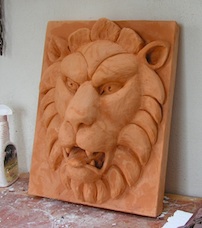
Lioness roundel progress

9-10-2010 progress view A

view B
I decided the shoulder didn’t look right so I gave it a more sweeping uplift;

9/5/2010 progress view

Now the model is roughed out, next I’ll be working on proportions. I had to move the left ear back a bit and the nose needs reduction yet, but she’s definitely taking on a lioness appearance even at this early stage.

No Comments »

Randall on September 3rd 2010 in Architectural models

Model Nr 27

Quick clip of the mostly dry model for size

No Comments »

Randall on September 2nd 2010 in Architectural models

New finds

I bought an 1872 cast iron corinthian capital which I just found in Chicago. It was part of the C. Holden building which is still extant but being gutted. The capital came from the interior columns and like my small one from Nashville it has the individually riveted-on leaves.

Having always been interested in geology, fossils, as well as space, I also acquired a couple of specimens of the Canyon Diablo meteorite in Arizona which were something I have seen around for sale but hadn’t gotten around to buying. So now I have a couple of chunks, the larger one is 215 gms, about 2″ across, mostly iron and nickel.
Really awe inspiring to imagine that iron-nickel meterite 50,000 years ago coming in at they estimate about 9 miles per second, and about 80 feet across slamming into the desert in Arizona to blast out that 1.2 km crater about 700 feet deep!
The explosion mostly vaporized the meteorite, but quite a lot of fragments of the metal were blown all over as far as about 6 miles away.

Of course no one knows where it came from, likely the asteroid belt between Mars and Jupiter, and probably once the molten core of a planet that might have been there. In any case, it was circling around and around for eons till it crashed in Arizona 50,000 years ago!

I was surprised to read a family bought the land the crater is on and this is privately owned! I thought it was part of the national park system or something of that sort, but no, it looks like this family bought the land around the 1900 intending to MINE it for what they thought would be a million tons of iron. Now it’s locked up as private property and no searching for meteorites is allowed. It’s become a tourist trap you have to pay $15 or $20 to even go in and look at from the top- they don’t allow anyone down on the crater floor.

I guess it’s a good thing the US Govt didn’t sell the Grand Canyon land or Yellowstone to private people, or these too would be locked up, fenced in private property with tourist trap buildings and pay-to-look deals.

No Comments »

Randall on September 1st 2010 in Architectural models

Lioness roundel

Now that the education panel model is a little past the leather hard stage I have it set aside to finish drying. It may yet wind up a little larger than I scaled for due to differences in clay shrinkage.

I decided to make the lioness model the same size as my wolf model is, I still have the template assembly I used to shape the clay round and concave, this would make it 20″ across with a 1″ border.
I also need to locate some good photos of the subject at hand, especially side views of lioness’ heads for depth.

I may start it this week once I finish up some casting and packing several items up for shipping.

No Comments »

Randall on August 29th 2010 in Architectural models

Lioness roundel

Think I figured out who made the lioness roundel, very likely American Terra Cotta co in Chicago, whose territory certainly would have included St Louis Mo.
I found in my book on the co history, a page from their old newsletter which is about 1914 showing a sampling of roundels for a livestock judging pavillion built for the University of illinois.
These have similar borders, and the quality of modelling with detail is strikingly similar, not that other TC co’s couldn’t do this, but the location and history make this co a likely one.
If so, then it’s also likely a well known Kristian Schneider was the modeller.

No Comments »

Randall on August 22nd 2010 in Architectural models

Concrete

Below is a photo of a concrete cast of lion 3886, unstained. This is 1 of 7 for a client who required embedded bolts on these to attach them to the wall on the exterior of his house over the windows.
This is just an example of some of the custom applications I am called upon to provide solutions for on retro- installations. As the client has access to the inside walls, his contractor will be able to drill 2 holes through the wood wall, spread on some thinset mortar or equiv., insert the rods through the wall and tighten the nuts up.
Outside he plans to stucco around the keystones and the wall.

No Comments »

Randall on August 22nd 2010 in Architectural models

Board of Education seal model No. 27

This model is finished today, I hollowed out the backside and it’s firming up nicely.

Finished image

Yesterday’s image,

I don’t plan to make a mold of this immediately, but can do so at any time.

I have 2 other model ideas in mind to accomplish before summer closes, that lioness roundel detailed further below this post, and a small version of the Commodore Hotel sun-god copper cornice mask.

Also, after some consideration, I decided to eliminate the “-R” extension in my model numbering system. When I began my sculpting career I decided to add that “-R” to each model number I sculpted, so as to put a designated barrier between my own models, and casts made directly from the antique pieces.
It made perfect sense for a while, but over time and with the addition of many of my own models to my line, phasing out some of the old ones, and rarely now making molds of the antique pieces, it no longer makes sense to have almost every model followed by a “-R.”
Over time that -R extension will go away on all of the store pages etc., so don’t let that confuse you, just ignore the -R when inquiring about a cast by number.

No Comments »

Randall on August 21st 2010 in Architectural models

Art Deco 8B in resin

I finished casting the last of 12 panels in resin for a client who wants them for her bathroom.

Attached a photo of 8 of them stacked against the wall awaiting cleaning up and finishing, several together offer some interesting design ideas.

These will be solvent cleaned and then they get primed with automotive primer and painted dirty nickel. These will go around the bathroom walls as a frieze near the ceiling.

No Comments »

Randall on August 18th 2010 in Architectural models

Lioness roundel

I saw a photo of a very charming, very interesting sculpture on what was originally the offices of US Steel Co., 311 South Sarah st, St Louis.
In fact, on this small one story building there are 7 of them!

I really like this!

It was once a US Steel office but is now occupied by the US Metals & Supply Co, probably a subsidiary of theirs.
I’ve so far found absolutely nothing on this building which is surprising.

The roundel appears to be about 24″ in diameter, and is overlaid on an oblong rectangular panel. I’m definitely considering making a model.

By the way, as I discovered on a Canadian Architecture site, a little tidbit of roundel history;

Medallions (or roundels) were a very fashionable form of ornament during the Renaissance; the most famous medallion maker was Luca Della Robbia in Florence. These are plaques, usually round, bearing figures or family symbols in relief. Sometimes they have stories or anecdotes. In the Art Deco period, these were left plain.

A roundel is a small circular decorative plate used extensively in Renaissance courtyards and arcades often a niche containing a bust.

So what we see of this shape in the US on facades would be a throwback or tribute to the Renaissance style’s use of these, even if the facade is not fancy Renaissance style, they used a key element from the style.

Here’s a link to the site to learn all about the names of various elements found on building facades, you will discover what we have in the US on facades in the older cities all has it’s basis in form taken from Europe, which is logical since it was the imigrants in the 1870′s 1880′s and 1890′s coming through Ellis island in NYC for processing, who brought the styles and stone carving skills with them.
Thumbnail image courtesy of Wampa-One
Larger image here;


Larger photo

Canadian architectural terms site;

No Comments »

Randall on August 12th 2010 in Architectural models

Art Deco

While waiting for the new model to firm up a bit more as the moisture evaporates from the clay slowly to finish detailing, refining and cleaning up the design, a client contacted me about my Art Deco panel 8B and the possibility of casting 12 of them thin to be used as tiles in her bathroom remodelling project.
After exchanging several emails about her project and discussing options, costs, advantages, disadvantages, I decided this project would work best with these cast being made in resin which is strong, lightweight, can be cast thin, and will accept the paints I use for most of my finishes.
As the client wanted the Old Dirty Nickel finish that will work just fine. The main drawback for resin is it’s cost, even casting these panels only 1/2″ thick it will take 4-1/2 gallons of resin, which for that amount runs a little over $275. That cost is about $9 more per panel which must be added onto my normal price for the cast-stone i normally use, but one advantage will be the fact that the shipping will cost her less, and the panels can ship in 1-2 boxes instead of 6-12, so the additional cost is partly if not completely offset by savings in shipping costs.
Resin is too expensive and more labor intensive to use for large, deep sculptures, it just takes too much of it, it begins setting rapidly, has to be brushed or troweled into the mold, and other techincal issues.
It also does not accept stains as I use for one of my finishes.

Resins tend to work best for sculptures like my 8B, or other relatively flat or small pieces.

Panel 8B Art Deco

No Comments »

Randall on August 12th 2010 in Architectural models

Education symbol model progress

8-7-10 photo;

Earlier photos;

I am thinking about adding somehting in the 2 bottom corners, so those are left unfinished for now!

Update; I experimented with a raised area in each corner but decided I didn’t like how it looked afer all, so the corners are just mitered.

A bit of historical trivia, from the July, 12th, 1898 NY Times;

The new seal of the Board of Education was used for the first time yesterday.The design is an open book, resting against the torch of wisdom, and surrounded by a wreath of ivy. Around the wreath are the words: Board of Education, City of New York.”

Comments Off

Randall on July 31st 2010 in Architectural models

Education symbol model

Part 7 in the series of modelling this sculpture.

Comments Off

Randall on July 31st 2010 in Architectural models